Guides
How Unicode Fonts Actually Work
Why 'fonts' you can copy and paste are not fonts at all, and what that means for you.
Short answer
They are not fonts. Each styled letter is a separate Unicode character that happens to look like a bold or italic version of the original. That is why the styling survives a paste into any plain-text field — and why the result is not searchable.
They are characters, not fonts
A real font is a file that tells your device how to draw the letter A. A copy-and-paste style does something different: it swaps the letter A for a completely separate character that happens to look like a bold or italic A. Those characters live in Unicode blocks such as Mathematical Alphanumeric Symbols, which were added so mathematicians could distinguish a bold vector from an italic scalar in formulas.
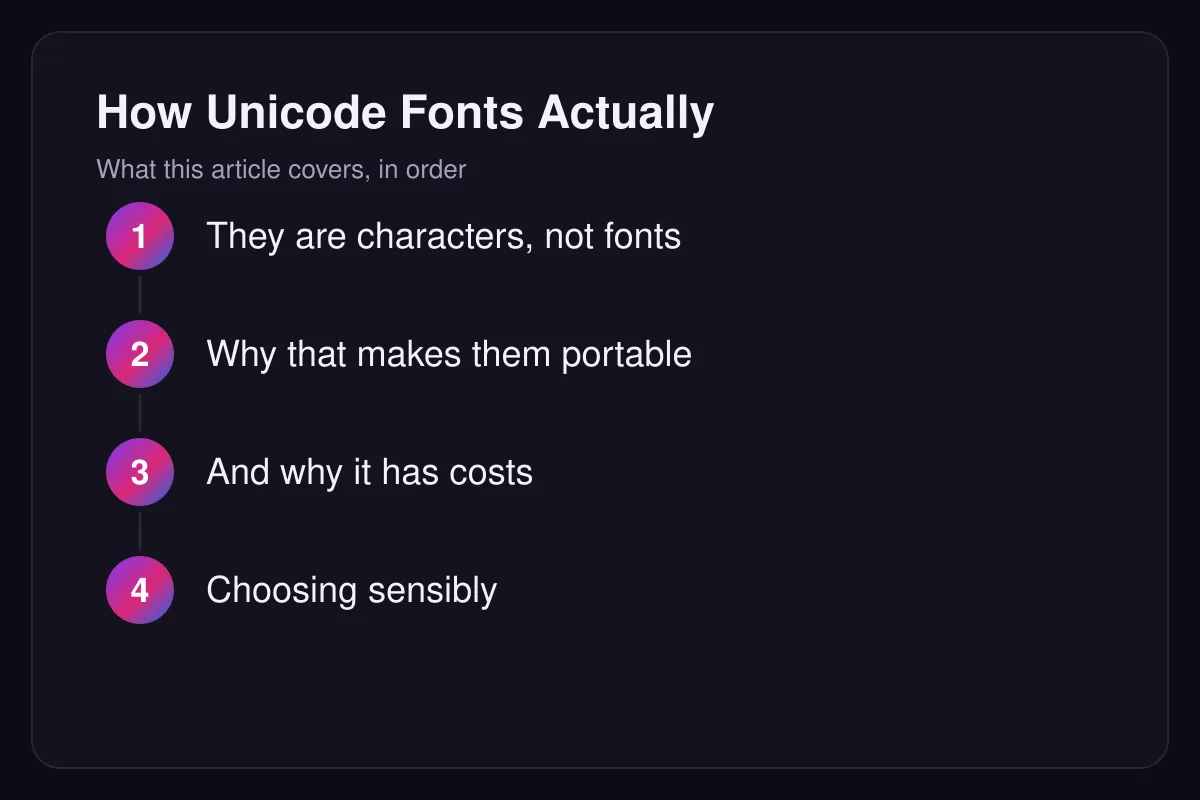
Why that makes them portable
Because the styling is baked into the character itself, it survives anywhere plain text goes — a bio field, a push notification, a filename. No formatting toolbar is required, because from the app's point of view you simply typed unusual letters.
And why it has costs
The same property causes the trade-offs. Search engines and site search do not treat 𝘽 as B, so styled keywords stop matching. Screen readers may read the characters one at a time, or skip them. And if a reader's device has no font covering that block, they see empty boxes instead of text.
Choosing sensibly
Use styled text for a short accent — a name, a heading, a divider — and keep the substance in ordinary letters. That keeps the page accessible and searchable while still looking distinct.
Questions
Why do some styles show boxes on my phone?
Are letters missing from some styles?
Read next
Sources
- Unicode Standard, Mathematical Alphanumeric Symbols (U+1D400–U+1D7FF)
The block that supplies bold, italic, script, fraktur and double-struck letters, and the reserved positions that create the gaps.
- Unicode Consortium — Code Charts
The official code charts for every block referenced here.