Use Cases
Zalgo Text
Glitch text built from stacked combining marks.
Short answer
Zalgo stacks combining diacritical marks on each letter. The marks have no width of their own, so they pile above and below the base character. Some apps cap or reject heavily stacked text.

Zalgo generator
g̵̨̥̞͎̈́̌̑̿͝l̵͈̟͖̤̀̔̄́́͠î̸̧̟̖̫͎̮̽̆̓̈́ṭ̸̡̨͖̏̇c̸̪̑ͅh̵̛̹̫̬̭͐̌̇̓
Higher intensity stacks more combining marks per character. Some apps cap or reject heavily stacked text, so test before posting.
How it works
Zalgo stacks many combining diacritical marks onto each letter. The marks have no width of their own, so they pile above and below the base character and spill into neighbouring lines.
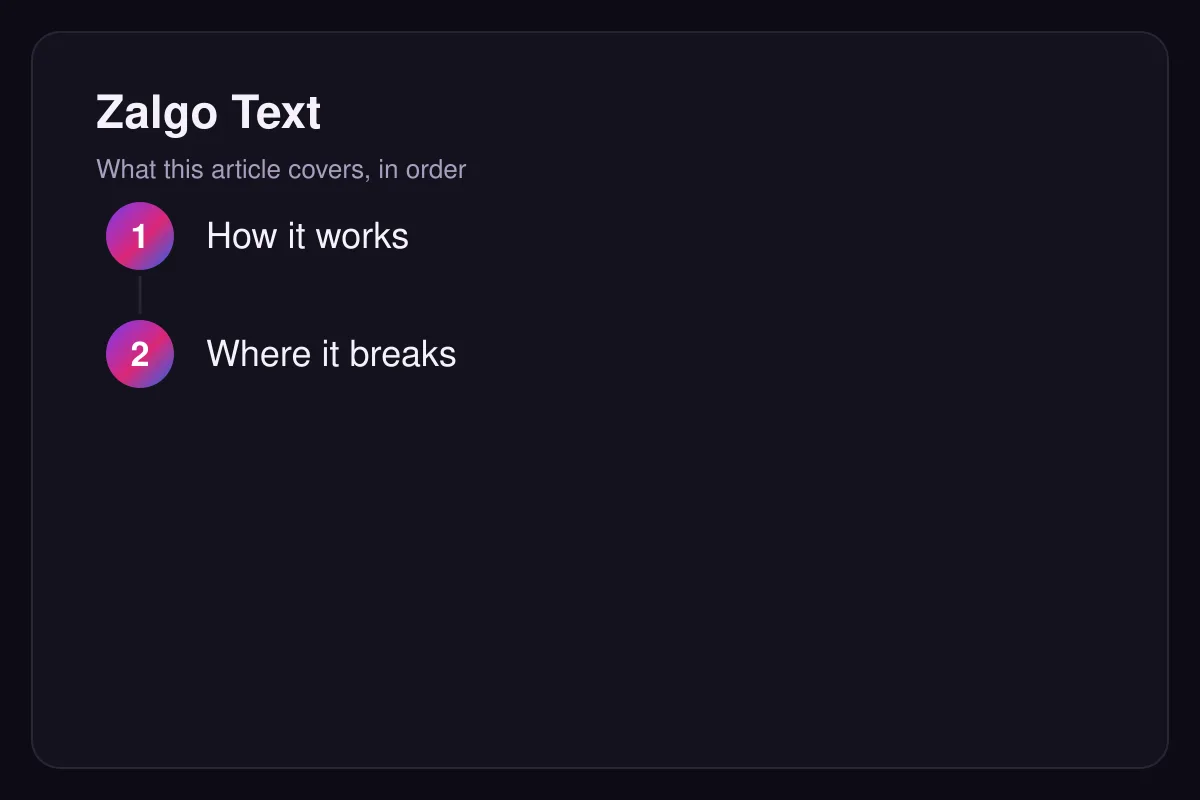
Where it breaks
Some apps cap the number of combining marks per character or reject the text outright, so heavy Zalgo may arrive trimmed or be rejected on submit.
Why some platforms strip it
Stacked combining marks can overflow their line box and overlap the text above and below, which breaks the layout of a feed rather than just the individual post. Platforms respond by capping the number of marks per character or rejecting the text outright. That is a rendering-safety decision, not censorship, and it is why heavy Zalgo often arrives trimmed.
Read next
Sources
- Unicode Standard, Combining Diacritical Marks (U+0300–U+036F)
The zero-width marks used for strikethrough, underline and stacked glitch effects.