Symbol Reference
Arrow Symbol (→)
Direction, flow and consequence.
Short answer
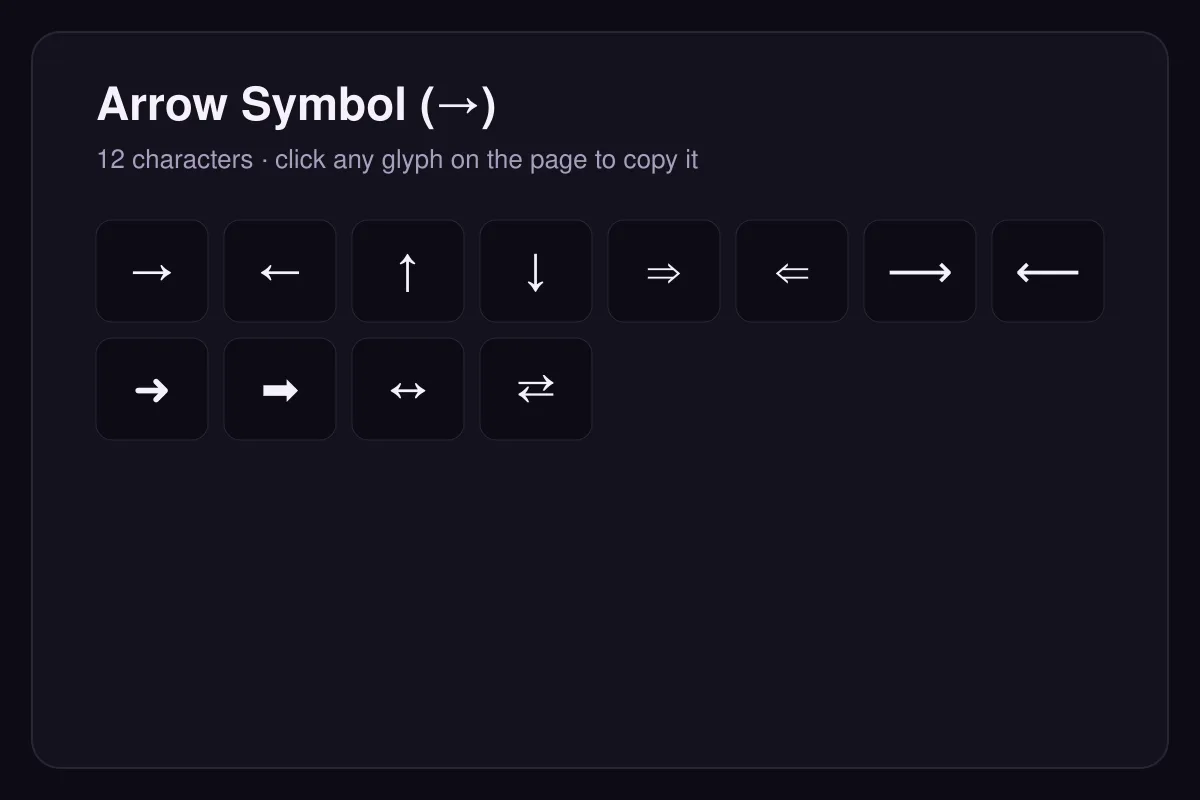
→ (U+2192) is the general-purpose arrow for direction, sequence and transformation. The double arrow ⇒ means logical implication and is not simply a heavier version of the same mark.

Where you'll actually meet it
Arrows express in one character what words would need a clause for: sequence, causation, transformation. In changelogs they show a version transition, in schedules a time change, in logic an implication. Because the meaning is contextual rather than fixed, an arrow is only clear when the surrounding text has established what kind of relationship it stands for.
Look-alike variants
The single arrow → means direction or transition; the double arrow ⇒ (U+21D2) means logical implication. Substituting one for the other changes the meaning in mathematical writing.
Uses
Arrows show sequence in notes and diagrams, transitions in schedules, and implication in logic, where ⇒ is read 'implies'.
Questions
What is the difference between → and ⇒?
Will arrows show up on every device?
Why there are hundreds of near-identical arrows
Unicode encodes meaning rather than appearance, so a rightwards arrow, a maps-to arrow, a tends-to arrow and an implication arrow each receive their own code point even where a font draws them almost identically. Mathematicians needed those relations distinguishable in typeset formulae, where the difference between 'maps to' and 'implies' is the difference between two unrelated statements. The result is several hundred arrow characters spread across four blocks, the great majority of which exist for a notational purpose rather than a decorative one — which is also why so many of them have patchy font coverage.
An arrow means only what the sentence has already established
Because the relationship it stands for is supplied by context, an arrow communicates nothing on its own. In a changelog it reads as a version transition, in a timetable as a change of time, in a recipe as the next step. That flexibility makes it excellent in short notes written for yourself and unreliable in anything a stranger reads cold. It is worse again for a screen reader user, who hears 'rightwards arrow' and must infer the relationship from surrounding text that may not state it.
How to type it
| Code point | U+2192 |
|---|---|
| HTML entity | → |
| Windows | Alt + 26 on the numeric keypad |
| macOS | no default shortcut; use the Character Viewer |
| Linux | Ctrl + Shift + U, then 2192, then Enter or Space |
Read next
Sources
- Unicode Consortium — Code Charts
The official code charts for every block referenced here.