Symbol Reference
Infinity Symbol (∞)
The lemniscate, introduced to mathematics in 1655.
Short answer
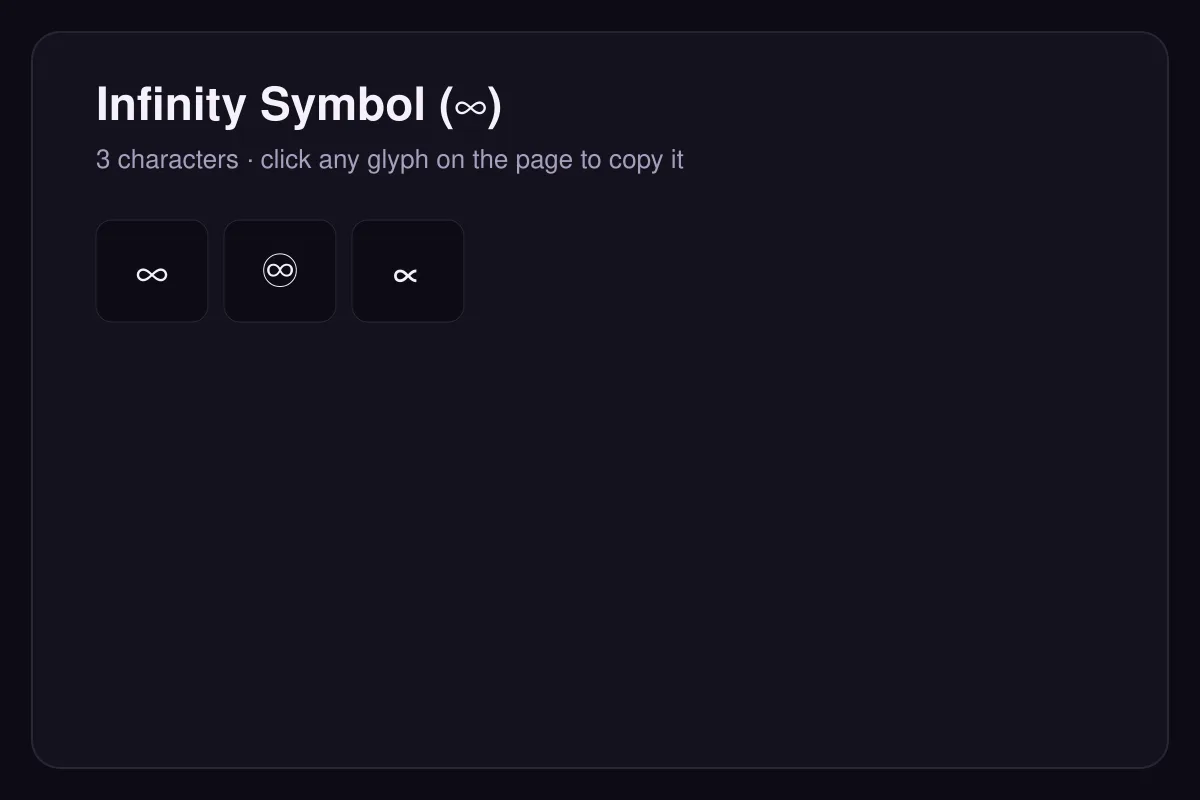
∞ (U+221E), introduced by John Wallis in 1655. It denotes unbounded behaviour rather than a quantity, which is why it cannot be manipulated arithmetically the way a number can.

Where you'll actually meet it
In mathematics the symbol appears in limits and in interval notation, where it marks an unbounded end rather than a value — a distinction that matters, because infinity cannot be treated arithmetically as a number. Outside mathematics it has become a general emblem of endlessness in jewellery and tattoo design, which is where most people actually encounter it.
Look-alike variants
The permanent-paper sign ♾ (U+267E) looks similar but means something entirely different — it marks paper meeting an archival durability standard. Do not substitute one for the other.
Origin
John Wallis introduced the sideways-eight in his 1655 treatise on conic sections. Its earlier history is uncertain — proposed sources include a variant Roman numeral for a large number and the Greek letter omega.
Questions
Is infinity a number?
Why is it shaped like a sideways eight?
The origin is genuinely unsettled
Wallis introduced the lemniscate in De sectionibus conicis without explaining where he got it, and every account of its earlier history is reconstruction rather than record. The most repeated explanation is that it derives from CIƆ, a Roman numeral form for one thousand that came to be used loosely for 'very many'. Another proposes omega, the last letter of the Greek alphabet, as a natural mark for the end of a series. Both are plausible; neither has direct evidence behind it. Anyone who tells you confidently which is correct has gone further than the sources allow.
The look-alike that means something else entirely
♾ (U+267E) is the permanent paper sign. It certifies that a book is printed on paper meeting an archival durability standard, and you will find it on the copyright page of a great many hardbacks. It resembles the infinity symbol closely enough that copy-and-paste sites routinely list it as a stylistic variant, but it is not one: putting it in a mathematical expression is simply an error, and putting it in a book makes a specific and checkable claim about the paper it is printed on.
How to type it
| Code point | U+221E |
|---|---|
| HTML entity | ∞ |
| Windows | Alt + 236 on the numeric keypad |
| macOS | Option + 5 |
| Linux | Ctrl + Shift + U, then 221E, then Enter or Space |
Read next
Sources
- Unicode Consortium — Code Charts
The official code charts for every block referenced here.