Symbol Reference
Peace Symbol (☮)
Designed in 1958 for the British nuclear disarmament movement.
Short answer
☮ (U+262E) was designed by Gerald Holtom in 1958 for the first Aldermaston march. The lines inside the circle are the semaphore flag positions for N and D, standing for nuclear disarmament.

Where you'll actually meet it
The symbol is most visible in protest imagery, where it keeps its original disarmament meaning, and in fashion and design, where it has broadened into a general emblem of peace. Its designer deliberately never trademarked or copyrighted it, which is a large part of why it spread as widely as it did and why anyone can reproduce it freely today.
Look-alike variants
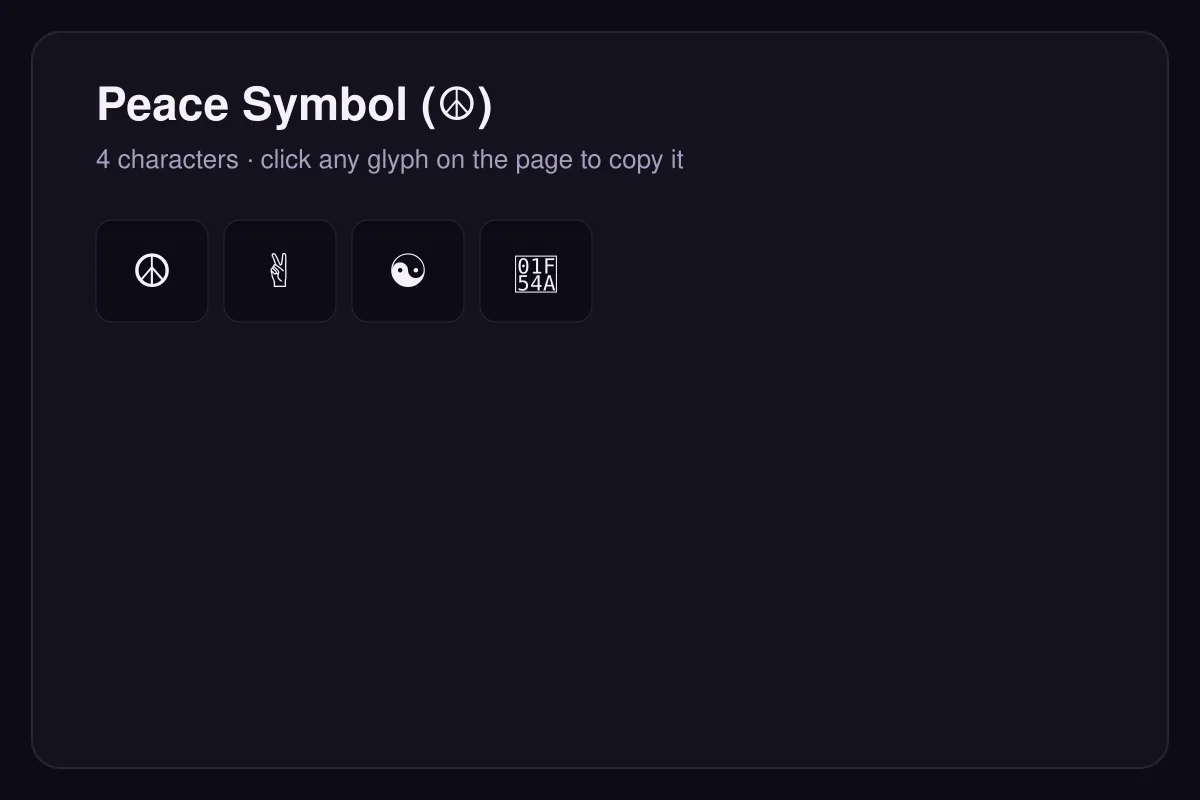
☮ is the nuclear-disarmament sign. The victory hand ✌ and the dove 🕊 carry related associations but are separate characters from different blocks, and the dove is an emoji rather than a symbol.
Origin
Gerald Holtom designed the mark in 1958 for the Direct Action Committee's Aldermaston march. The lines combine the semaphore positions for the letters N and D — nuclear disarmament — inside a circle.
Questions
Who designed the peace symbol?
Is the peace symbol copyrighted?
How the design encodes its meaning
Semaphore signals a letter by the angle of two flags. N is both flags held downwards in a V; D is one raised vertically and one lowered. Holtom superimposed the two and enclosed them in a circle standing for the world. He later wrote that the downward lines also expressed despair — a figure with arms outstretched and lowered — and said he had come to wish he had drawn it inverted, as a gesture of hope. That second reading comes from his own correspondence rather than from any design brief, so it is his interpretation of what he had made rather than the intention he set out with.
Why it belongs to nobody
Holtom and the Direct Action Committee deliberately did not trademark or copyright the mark, and the decision was explicit rather than an oversight: a symbol nobody owned could be reproduced by anyone, on anything, without permission or payment. That is a large part of why it travelled from one British march to worldwide recognition within a decade. It also means the mark carries no authorised meaning — its associations have broadened well past nuclear disarmament into a general emblem of peace and, at times, into pure decoration, a drift some of its original users have found uncomfortable.
How to type it
| Code point | U+262E |
|---|---|
| HTML entity | ☮ |
| Windows | Alt + 9774 on the numeric keypad |
| macOS | no default shortcut; use the Character Viewer |
| Linux | Ctrl + Shift + U, then 262E, then Enter or Space |
Read next
Sources
- Unicode Consortium — Code Charts
The official code charts for every block referenced here.