Symbol Reference
Degree Symbol (°)
Marks temperature, angles and geographic coordinates.
Short answer
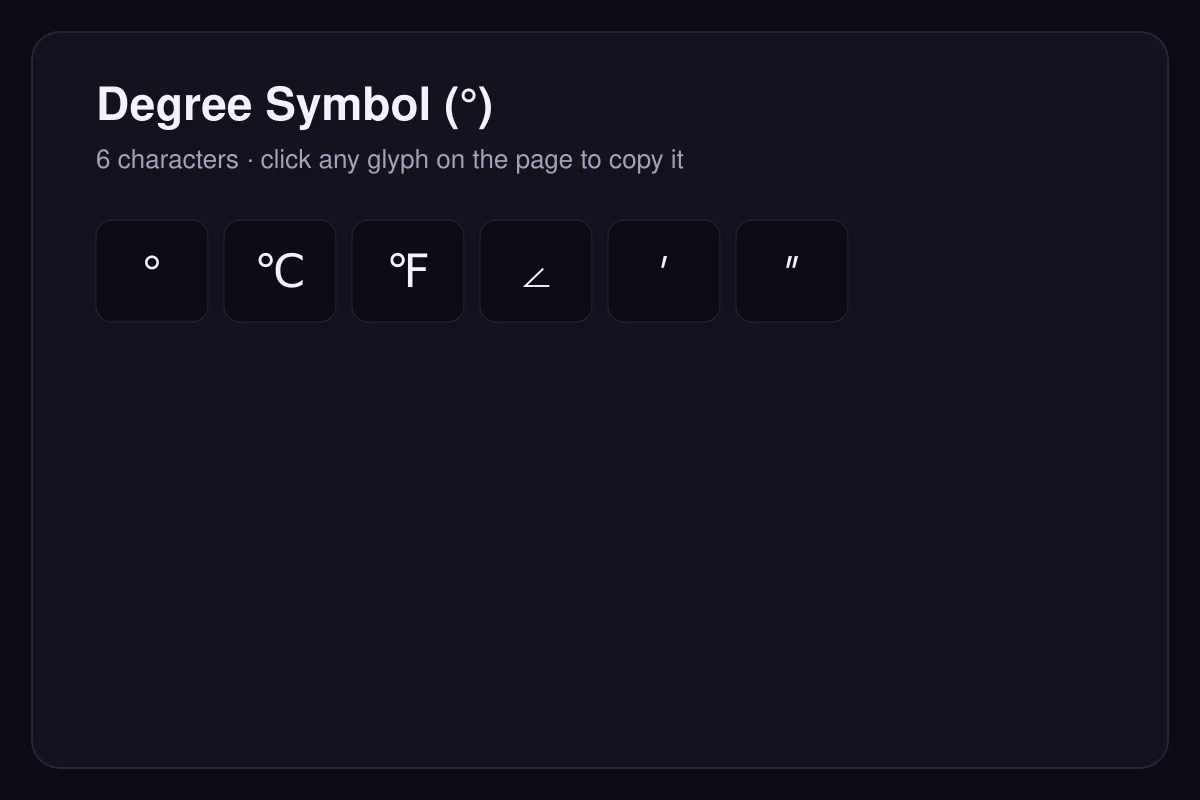
One character, U+00B0, covering temperature, angles and coordinates. Its most frequent failure is being confused with the masculine ordinal indicator º, which looks nearly identical at small sizes but is a different character.

Where you'll actually meet it
Temperature is the everyday use, but the degree sign also marks angles, compass bearings and the degree component of latitude and longitude, where it is followed by minutes and seconds. A frequent error is substituting an apostrophe and a quotation mark for those two units; the correct characters are the prime and double prime, which are upright rather than curled and are separate code points.
Look-alike variants
℃ (U+2103) and ℉ (U+2109) are single characters combining the degree sign with a unit letter. They exist for compatibility with legacy encodings; writing the degree sign followed by C or F separately is generally preferred.
Correct usage
For temperature the degree sign sits between the number and the unit letter: 21 °C in SI style, or 21°C in most everyday writing. For angles and coordinates it attaches directly to the number: 45°.
Questions
Is there a space before the degree sign?
What is the difference between ° and the masculine ordinal º?
Why a circle has 360 degrees
The division is Babylonian, and it survived because 360 is unusually cooperative: it divides evenly into halves, thirds, quarters, fifths, sixths, eighths, ninths, tenths and twelfths without leaving a remainder. That property is why the convention outlived the base-60 arithmetic it came from, and it is also why the sub-units are minutes and seconds of arc rather than decimal fractions — the same base-60 subdivision, carried forward twice.
The prime is not an apostrophe
Minutes and seconds of arc are marked with the prime ′ (U+2032) and double prime ″ (U+2033), which are upright and slightly slanted. Substituting an apostrophe and a double quotation mark is extremely common and wrong, and it gets worse rather than better in most editors: smart-quote substitution curls them into typographic quotes, which is immediately visible to anyone reading a chart, a survey or a set of coordinates. The same two prime characters mark feet and inches, so the error travels well beyond geography.
How to type it
| Code point | U+00B0 |
|---|---|
| HTML entity | ° |
| Windows | Alt + 0176 on the numeric keypad |
| macOS | Option + Shift + 8 |
| Linux | Ctrl + Shift + U, then 00B0, then Enter or Space |
Read next
Sources
- Unicode Consortium — Code Charts
The official code charts for every block referenced here.