Symbol Reference
Copyright Symbol (©)
Marks a work as protected by copyright.
Short answer
© (U+00A9) states who owns a work and from when. Under the Berne Convention it is no longer required for copyright to exist, so what remains is a practical function rather than a legal one.

Where you'll actually meet it
You will see the copyright notice in page footers, book colophons and image credits. The convention is the symbol, then the year of first publication, then the rights holder. Since the Berne Convention the notice has not been required for protection to exist, so its function now is practical: it tells a reader who to approach for permission, and it forecloses any argument that an infringement was innocent.
Look-alike variants
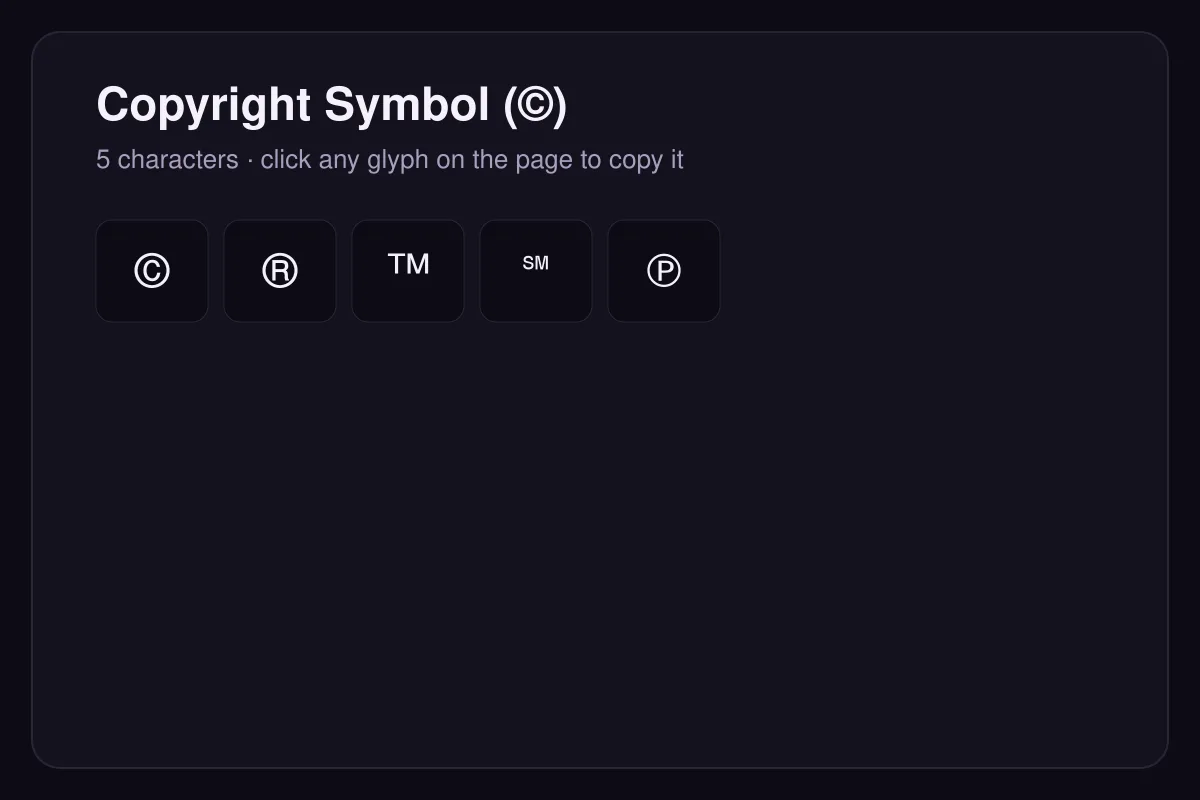
® (U+00AE) marks a registered trademark, ™ (U+2122) an unregistered one, and ℗ (U+2117) a sound recording. These are legally distinct marks, so the right one matters.
When you need it
Under the Berne Convention copyright exists from the moment a work is fixed, so the notice is no longer required for protection in signatory countries. It is still widely used to state ownership and year clearly.
Questions
Do I still need a copyright notice?
Can I write (c) instead?
What the notice actually buys you now
Once the notice stopped being a condition of protection, its remaining value became evidential. It identifies who to approach for permission, it fixes the year of first publication in a form that travels with the work wherever it is copied, and in several jurisdictions it forecloses a defence of innocent infringement — the argument that a copier neither knew nor could reasonably have known the work was protected. That is worth having. It is also considerably less than most people assume they are getting when they add the symbol.
Four marks that are not interchangeable
© covers the work itself. ® marks a trademark actually registered with a national office, and applying it to an unregistered mark is an offence in a number of countries rather than merely inaccurate. ™ asserts an unregistered trademark and makes no registration claim at all, which is why it is the safe choice while an application is pending. ℗ is the separate mark for a sound recording, which is why a record sleeve often carries both © and ℗ with different years — the composition and the recording of it are distinct works with distinct dates.
How to type it
| Code point | U+00A9 |
|---|---|
| HTML entity | © |
| Windows | Alt + 0169 on the numeric keypad |
| macOS | Option + G |
| Linux | Ctrl + Shift + U, then 00A9, then Enter or Space |
Read next
Sources
- Unicode Consortium — Code Charts
The official code charts for every block referenced here.