Symbol Reference
Asterisk (*)
A star-shaped mark used for footnotes, emphasis and wildcards.
Short answer
A star-shaped mark meaning footnote in print, wildcard in code, and emphasis or correction in chat. Use the plain ASCII asterisk unless you specifically need the mathematical operator ∗.

Where you'll actually meet it
In footnotes the asterisk is conventionally the first marker, followed by the dagger and double dagger before numbering takes over. In shells and search syntax it is the wildcard matching any sequence of characters. In chat it wraps a word for emphasis where formatting is unavailable, and a lone asterisk before a word marks a correction to an earlier message — a convention that predates edit buttons and has outlived them.
Look-alike variants
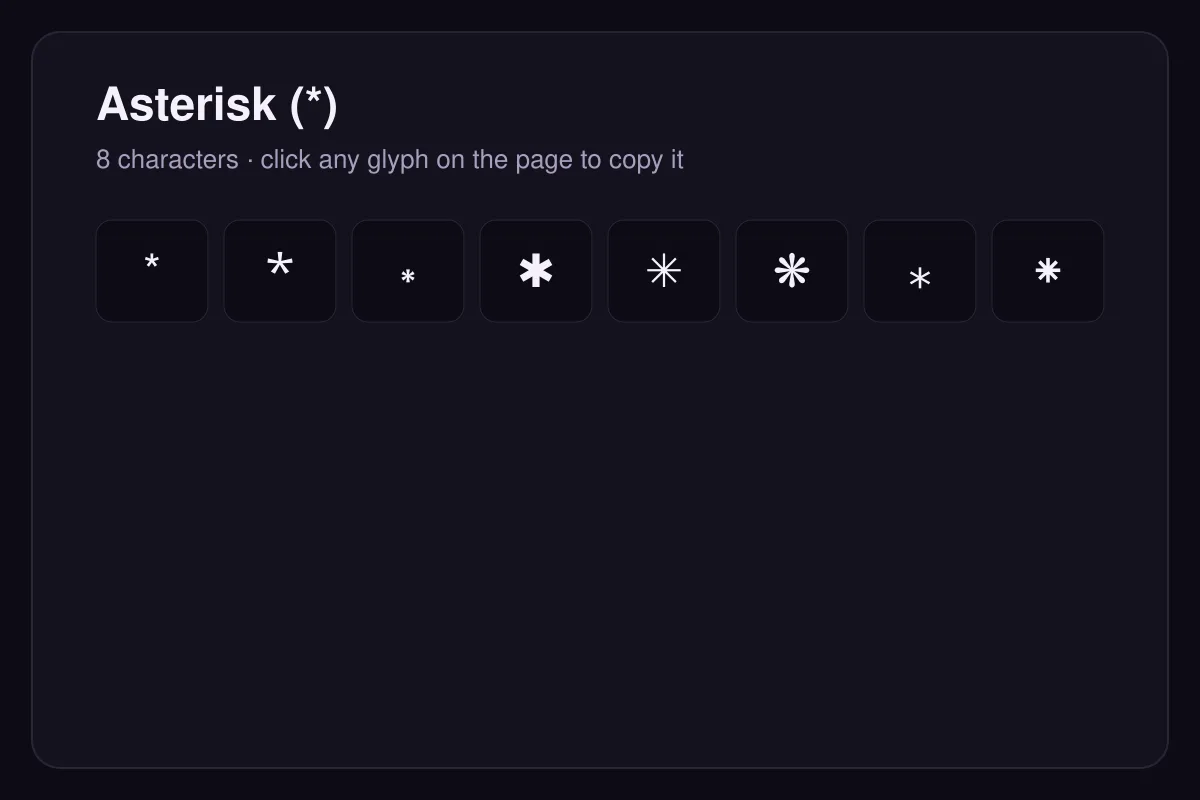
The typographic asterisk ∗ (U+2217) is a mathematical operator, and the heavy variants ✱ ✳ ❋ come from Dingbats. Use the plain ASCII asterisk unless you specifically need a mathematical operator, since only the ASCII one is understood everywhere.
Uses
In print it flags a footnote. In code it multiplies, dereferences, or matches anything. In chat it wraps a word for emphasis or marks a correction to an earlier message.
Questions
What order do footnote symbols go in?
Why do people put asterisks around words in chat?
Older than the printing press
Asteriskos is Greek for 'little star', and the mark was already in scholarly use in Alexandria, where editors of Homer used it in the margin to flag a line duplicated from elsewhere in the text. Its companion mark, the obelus, marked a line thought spurious. That editorial job — a symbol standing outside the text pointing at something that needs a note — has survived essentially unchanged for more than two thousand years, which makes the asterisk one of the oldest continuously used marks in Western punctuation.
Why an asterisk in a filename is a bad idea
In shells and in most search syntaxes the asterisk is a wildcard matching any sequence of characters, and crucially it is expanded before the command runs. A command you intended to apply to one file can therefore match everything in the directory instead. This is not a hypothetical: it is the standard way people delete more than they meant to. If you must have one in a name, quote or escape it, and expect tools that were not written carefully to mishandle it anyway.
How to type it
| Code point | U+002A |
|---|---|
| HTML entity | * |
| Windows | Shift + 8 |
| macOS | Shift + 8 |
| Linux | Ctrl + Shift + U, then 002A, then Enter or Space |
Read next
Sources
- Unicode Consortium — Code Charts
The official code charts for every block referenced here.